
La energía fotovoltaica (FV) es el proceso de convertir la luz en electricidad. La tecnología fotovoltaica convierte la luz del sol (también conocida como radiación solar) en electricidad de corriente continua. Este proceso utiliza semiconductores (el material semiconductor más común es el silicio cristalino), de modo que cuando el sol incide sobre el fotovoltaico, los electrones se liberan y forman una corriente eléctrica.
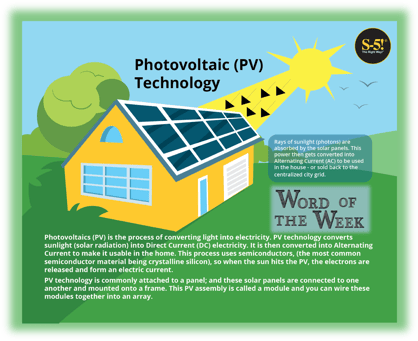 La tecnología fotovoltaica suele ir unida a un panel; y estos paneles solares se conectan entre sí y se montan sobre un bastidor. Este conjunto fotovoltaico se denomina módulo y puede conectarse entre sí formando un conjunto. Los rayos del sol (fotones) son absorbidos por los paneles solares. Esta energía se convierte en corriente alterna (CA) para utilizarla en casa o venderla a la red centralizada de la ciudad.
Los rayos de sol (fotones) son absorbidos por los paneles solares. Esta energía se convierte en corriente alterna (CA) que se utiliza en la casa o se vende a la red centralizada de la ciudad.
The National Laboratory of the Rockies describes photovoltaic technology in the following terms: “Solar cells, also called photovoltaic (PV) cells by scientists, convert sunlight directly into electricity. PV gets its name from the process of converting light (photons) to electricity (voltage), which is called the PV effect. The PV effect was discovered in 1954, when scientists at Bell Telephone discovered that silicon (an element found in sand) created an electric charge when exposed to sunlight. Soon solar cells were being used to power space satellites and smaller items like calculators and watches.”

Solar cells electrically connected to one another are termed a photovoltaic module. When you wire a number of modules together, you create an array. The area of a module or array determines the amount of electricity that can be produced.
Deconstrucción de palabras
Word of the Week: Photovoltaic (PV)
PRONUNCIACIÓN: \ foh-toh-vol-tey-ik
PARTE DE LA HABLA: Sustantivo y adjetivo
SENTENCE: // The advent of PV technology enables electricity production to transition from large centralized facilities to residential rooftops – allowing individuals to produce their own electricity and become prosumers.
.png?width=320&name=Solar%20Panel%20Installation%20with%20the%20S-5!%C2%AE%20PVKIT%E2%84%A2%202.0%20(Top%20View).png) SINÓNIMOS Y PALABRAS RELACIONADAS: FV, solar fotovoltaica, matriz FV, tecnología FV, paneles solares, fijaciones solares, montada sobre raíles, sin raíles, tecnología FV solar, energía solar fotovoltaica, energía renovable, electricidad, red, industria solar, células FV, electrones, semiconductores, radiación solar, corriente eléctrica, etc.
SINÓNIMOS Y PALABRAS RELACIONADAS: FV, solar fotovoltaica, matriz FV, tecnología FV, paneles solares, fijaciones solares, montada sobre raíles, sin raíles, tecnología FV solar, energía solar fotovoltaica, energía renovable, electricidad, red, industria solar, células FV, electrones, semiconductores, radiación solar, corriente eléctrica, etc..png?width=315&name=Solar%20Panel%20Installation%20with%20the%20S-5!%C2%AE%20PVKIT%E2%84%A2%202.0%20(Side%20View).png)
HISTORY OF PHOTOVOLTAIC: Photovoltaic comes from the Greek word – φως (fo̱s) – light. Voltaic comes from the inventor of the electrochemical battery – Alessandro Volta. PV arrays, also termed solar fixings, can be installed on rooftops, walls, as well as on the ground. Through rail less (direct mount) or rack and rail systems, solar panels can be installed providing at least a 30-year alternative power source.
¡S-5! Soluciones solares
PVKIT® Rail-Less Metal Roof Solar Mount
La forma correcta® de instalar energía solar fotovoltaica:
 VÍDEO: Vea las características del PVKIT® 2.0
¿Por qué el nuevo PVKIT® 2.0 es The Right Way?


